The Hijacking of Humanity
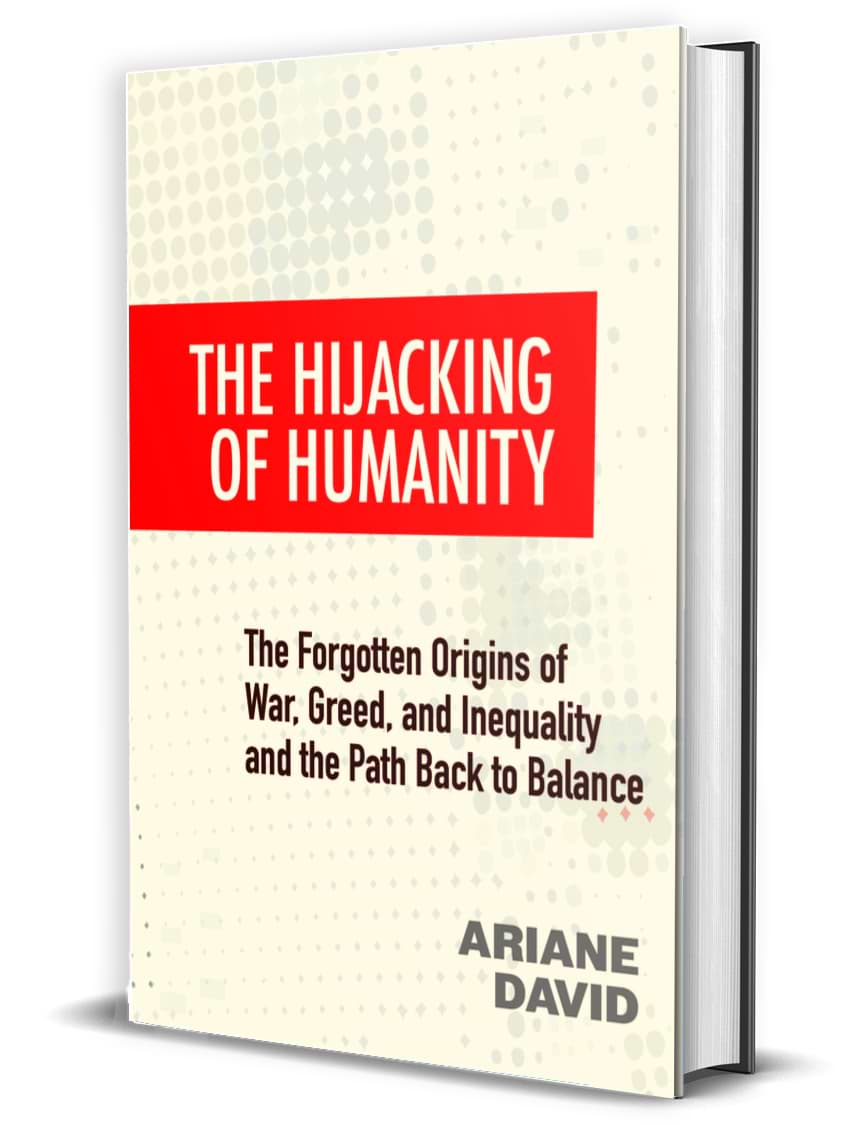
Ariane David
When The Hijacking of Humanity guides the reader through our momentous transition from foraging to farming, from small villages to densely populated towns and cities, and from a largely economically and politically egalitarian social structure to a class-based structure in which women had little formal power.
The book investigates what I refer to as the super-myths – cultural conventions so all-encompassing that they define a people’s entire way of life, including its most fundamental beliefs, values, religions, and even its history – that locked this new social order in place.
I explore the role they continue to play today in the perpetuation of chronic war, resource inequity, and social injustice, and the disastrous effects on society that occurred when they silenced women’s voices and removed women from the public realms of politics and economics. Most importantly, in The Hijacking of Humanity, I propose a plan to return to balance.
The seventeenth-century philosopher Thomas Hobbes contended that man, in his natural state, was by nature murderous and selfish, and he lived in “a condition of war of everyone against everyone.” He maintained that, as a result, were it not for Civilization as he knew it, human life would be “solitary, nasty, brutish, and short”.
To the great detriment of humanity, we have remained tethered to these beliefs, and the inevitable conclusion that humans are hard-wired for self-destruction. This stunted vision of humanity offers no hope, and what’s worse, for all its popular appeal, it is dangerously wrong.
But archaeological evidence points to a completely different kind of human. Rather than a bloodthirsty man who killed his rivals for meat and women, securing the survival of his murderous genes, and his submissive woman waiting for him to return from the hunt with meat to feed the family, homo sapiens was a species whose actual survival strategy was cooperation, peacefulness, generosity, and equality of the sexes.
There is no scientific evidence that pre-agricultural peoples had as yet invented chronic war, wealth, social stratification, or gender. All of that came later with a development in human history so momentous that it commandeered people’s thinking and forever changed how they lived. It started as human beings settled down in tiny camps to hunt and gather.
Over the course of thousands of years, men and women together domesticated animals and cultivated grains, and the camps grew into densely populated towns and cities. There, they invented heritable wealth and ritualized warfare. As I demonstrate in The Hijacking of Humanity, it was during these millennia that women began to lose their status.
Ten thousand years ago, women were the dependable food providers, bringing in the majority of the calories consumed by the band. Within a few thousand years, as agriculture replaced gathering and hunting, women went from being the breadwinners to performing the most laborious and burdensome tasks in the community that left them no time to engage in public life.
It was a time when men became Man and women disappeared as a driving force in politics and economics. With the loss of women’s decision-making contributions, over the millennia the human social system began to wobble out of balance and remains out of balance today. Recent events, including the COVID-19 pandemic, have demonstrated like no other time in history that the thinking that brought humanity to this point in our evolution is no longer sustainable.
Yet, as I will show, our fate is not sealed.
Share this page
Newsletter
Get Ariane David’s writing delivered to your inbox.
Substack
Invite Ariane to Speak
[One line on talks, interviews and events. Copy to come from Ari.]